Biometabolism and Technometabolism

The capacity for culture, together with human dexterity, led to one particularly important difference between the ecology of our species and that of other mammals. The regular use of fire and the manufacture and use of tools added an extra dimension to the metabolism of human populations – referred to as technometabolism.

Technometabolism is defined as the pattern of flow of energy and materials into, through and out of a human population that results from technological processes. It contrasts with biometabolism, which is the flow of energy and materials into, through and out of human organisms themselves. Of course, some other animals use tools, but technometabolism on the scale seen in human populations is a new

phenomenon in the history of life on Earth. It is of tremendous significance ecologically, and in many other ways.

In particular, the use of fire was a development of enormous ecological significance. It was the first example of the regular and deliberate use by humans of extrasomatic energy – energy, that is, which is used outside the human body, as distinct from the somatic energy which is consumed in food, flows through the human body and is dispersed in the form of heat.

It has been estimated that the introduction of the regular use of fire in human populations approximately doubled the per capita energy use, bringing the average total energy used per day per person (men, women and children) to about 14 MJ: that is, roughly 7 MJ used in biometabolism and 7 MJ in the burning of wood.

In the early farming ecological phase of human history, and in the early urban phase, new technologies were introduced that resulted in some intensification of technometabolism. In particular, there was an input of various metals, especially iron and the combustion of wood as a source of energy for smelting.

There has been an explosive increase in the intensity of technometabolism in ecological Phase 4 of human history – the Exponential Phase or the Anthropocene. Humankind is now using 20,000 times as much extrasomatic energy as was the case when farming began, and 95 per cent of this increase occurred over the past 150 years. Also, vast quantities of many different elements are used in technological processes and in the manufacture of a great range of different kinds of artefacts. The per capita consumption of iron in Australia today is over 1.3 kg per day.

The analysis of flows of materials and energy into, through and out of urban systems has now become an important field in human ecology. An early example is the study of the metabolism of Hong Kong [1].

Patterns of urban metabolism have an important influence on the health of human populations and of the ecosystems of the biosphere.


[1] Newcombe, K,, J. D. Kalma and A. Aston. 1978. The metabolism of a city: the case of Hong Kong. Ambio.  Vol. 7, No. 1, pp. 3-15.

Boyden, S., S. Millar, K. Newcombe, B. O’Neill, 1981. The ecology of a city and its people: the case of Hong Kong.  ANU Press, Canberra.

A Generational Perspective

Picture yourself on the stage of a large theatre with room for an audience of two thousand. In your mind’s eye, place your mother in the seat at the end of the front row, to your left, and then her mother next to her and so on – until you have filled the theatre with 2,000 generations of mothers and daughters.

Only your mother and the two or three ladies on her left would have seen motor vehicles. The women in the front two rows would have lived after the first cities came into existence, and those in the front six or seven rows would have lived after farming began. All the other maternal ancestors in the theatre, over 1800 of them, lived in the hunter-gatherer phase of human history.

You could fill five other similar theatres with earlier maternal hunter-gatherer ancestors belonging to the species Homo sapiens.

If you were to carry out the same mental exercise imagining you were in a stadium with seats for 100,000 people, the ladies in the back rows would be australopithecines.

The tyranny of culture and cultural gullibility

The Bionarrative draws our attention to the tendency of humans to accept as gospel the messages coming from their close cultural environment. While occasional individuals reject some of the assumptions, attitudes and prejudices of the culture in which they have grown up, they are a minority. Most people remain true to their cultural inheritance throughout their lives. This natural tendency of humans to blindly accept the assumptions of the cultural soups in which they have been immersed since childhood lies behind most of the conflicts between different ethnic and religious groups in the modern world. Cultural gullibility is a fundamental, and potentially very dangerous, human characteristic.

The Bionarrative thus alerts us to the brainwashing power of culture, and to the critical need to be constantly vigilant – making sure that the worldviews and , assumptions of our cultures are in tune with reality; and that they are not leading us to behave in ways that cause unnecessary human distress or damage to the living environment.

Cultural Maladaption and Cultural Reform

As cultures evolve, they sometimes come to embrace not only information of good practical value, but also assumptions that are sheer nonsense, leading to behaviours that are equally nonsensical. That is, cultures often get things wrong. Sometimes these cultural delusions result in activities that cause unnecessary distress in humans, or unnecessary damage to local ecosystems. There are countless examples of cultural maladaptation in human history.

Fortunately, humans have the ability, through their capacity for culture itself, to bring culture back on track when it goes off the rails. Nowadays, when people come to perceive the biological or social consequences of culturally-inspired activities as undesirable, a period of discussion and debate ensues about the causes of the problem and possible remedies. Eventually new understanding can bring about modifications in cultural assumptions and priorities, leading to appropriate changes in human activities. This process is referred to as cultural reform.

Cultural reform is often quite complicated, involving prolonged interactions between different interest groups in society. A key role is sometimes played initially by minority groups, occasionally by single individuals, who start the ball rolling by drawing attention to an unsatisfactory state of affairs. An example is Rachel Carson who, in her ground-breaking book Silent Spring, drew attention to the insidious and destructive ecological impacts of certain synthetic pesticides.

Almost invariably these expressions of concern coming from reformers are promptly contradicted by others, the counter-reformers, who set out to block the reform process. This predictable backlash often involves, but is not restricted to, representatives of vested interests who believe that the proposed reforms will be to their disadvantage. They are likely to argue that the problem does not exist, or that it

has been grossly exaggerated, and they try to ridicule the reformers by calling them alarmists, fanatics, scaremongers and prophets of doom. Nowadays some of the counter-reform forces are extraordinarily powerful. For a detailed discussion in the context of tobacco smoking, CFCs and climate change – see Merchants of doubt by N. Oreskes and E.M. Conway (2010).

Eventually, if the reformers are successful, a change comes about in the dominant culture, and members of governmental bureaucracies and other organisations set about working out ways and means of achieving the necessary social changes. Their efforts may still be hindered by the stalling tactics of counter-reformers.

The Partial Enlightenment

Towards the end of the 17th century and during the 18th century the intellectual movement commonly referred to as ‘the Enlightenment’, was underway in Europe. This movement emphasised rational thought, as opposed to religious tradition, as a means of understanding the universe and making things better for humankind. A more appropriate term would be ‘Partial Enlightenment’. Its great weakness lay in its association with the idea that Nature is out there to be conquered.

Francis Bacon is credited with originating the idea of improving the human condition by conquering Nature, and Descartes believed that we should become ‘like masters and possessors of Nature’.

Does it make sense to set out to conquer the living system that gave rise to us, of which we are a part, and on which we are totally dependent? No, it does not; but it does make sense to try to understand it, to respect it, and to seek to live in harmony with it.

Nature, Culture and the Future

The human species has a trait that is unique in the animal kingdom. It is the ability to invent, memorise and communicate with a symbolic spoken language. This aptitude for language led to the accumulation of shared worldviews, knowledge, beliefs and attitudes in human groups. That is, it led to human culture.[1]

 In recent times human culture has become an extremely powerful force in the living world.

Shared knowledge, beliefs, ideologies and priorities can lead to human activities that are to human advantage. These are referred to as cultural adaptations. But culture can also get things wrong, and it can sometimes result in activities that are disadvantageous.   These are referred to as cultural maladaptations.

Cultural maladaptations in the modern world are on a massive scale, and if present patterns of human activity continue unabated the collapse of civilisation certain.

Paradoxically, while culture is responsible for the current threats to human wellbeing and survival, it is only through culture that we can hope to overcome them. 

An aspect of culture of special pertinence in this context is what Yuval Harari calls ‘holy scripts’. This author describes how all belief systems, including religions and political ideologies, have their holy scripts.[2] These holy scripts provide the underlying basis of the belief systems and they sometimes have a powerful influence on people’s worldviews and behaviour. 

It is our contention that the prevailing cultures of the world suffer from a very serious deficiency in this area of holy scripts, and that this deficiency lies behind many of the current cultural maladaptations that threaten humanity today.  We have the sacred writings of the various religious belief systems, including Buddhism, Hinduism, Christianity, Judaism and Islam, and we have the hallowed texts of communism and capitalism. But there is another story, of profound significance for every one of us and for society as a whole, that has yet to find its place among the assortment of holy scripts. It is the story about life on Earth and the human place in nature. We call it the Bionarrative. The Bionarrative is a true story that comes from the natural sciences. Certainly, there are many people who are familiar with this story, but they are very much in a minority. The Bionarrative is not seen as a story of political or ethical significance. It is not a holy script.

The bionarrative generates an understanding of the human place in nature and of the life processes that gave rise to us, of which we are a part, and on which we are totally dependent, and it highlights the urgent need for radical changes in the patterns of human activity on Earth if civilisation, and perhaps our species, are to survive. The prospects for the future of humankind would be very much brighter if the Bionarrative were embedded at the core of the prevailing cultur


[1] The word culture has many rather different meanings. Here it is used to mean the abstract products of the capacity for culture, such as learned language itself and the accumulated knowledge, assumptions, beliefs, values and technological know-how of a human population. This use of the term is consistent with the first definition of ‘culture’ given in Collins Dictionary: ‘The total of the inherited ideas, beliefs, values and knowledge, which constitute the shared bases of social action’ (Collins Dictionary of the English Language (1979) Collins, Sydney, Auckland and Glasgow).

[2] Harari refers to ideologies, like communism and capitalism, as religions. Here we use the expression ‘belief systems’ to include both religions that embrace a belief in a god or gods and political ideologies which do not embroil a god or gods. Y. N. Harari. 2011. Sapiens: a brief history of humankind. Vintage Press, London. p. 254.

A Biosensitive Society

Biounderstanding leads us to the inescapable conclusion that the only hope for the future lies in a radical cultural transformation, leading to a new ecological phase of human history – a phase that is truly sensitive to, in tune with and respectful of the processes of life that underpin our existence. We refer to a society with these characteristics as a Biosensitive society [1].

In biosensitive societies the prevailing cultures will:

– hold deep respect for nature and the processes of life that underpin our existence

– perceive the achievement of harmony with nature as supremely important, to be given the highest priority in human affairs.

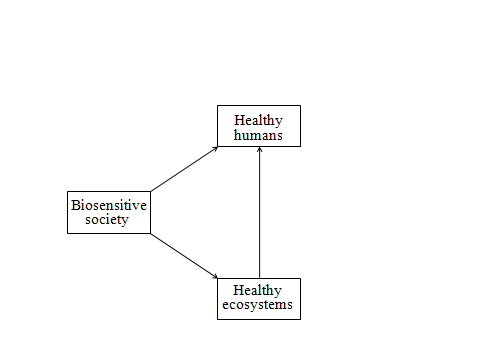
A biosensitive society will promote health and wellbeing in all sections of the human population and in the ecosystems of the biosphere (Figure 1).

Figure 1: Biosensitivity Triangle

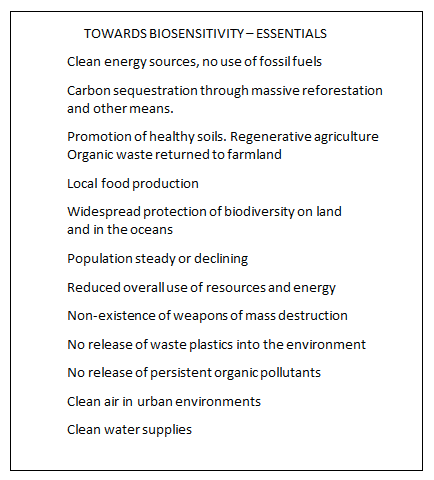
Table 1 lists some the most essential features of a society on the path to biosensitivity. The achievement of these goals will require strong and enlightened government action. Governments will also oversee a transition to a new economic system that satisfies the needs of all sections of the human population without resulting in ever-increasing consumption of natural resources and production of wastes.

Table 1


GOVERNMENT ACTION

The achievement of these goals will require strong and enlightened government action. Unlike today, they will all be given high priority by governments and local authorities.

Governments will oversee a transition to a new economic system that satisfies the needs of all sections of the human population, without resulting in ever-increasing use of natural resources and production of wastes. There must be a steady decline in the intensity of technometabolism [see Biometabolism and Technometabolism].

Biosensitive societies will be free of weapons of mass destruction, which at present pose an horrendous threat to humankind and the rest of the biosphere.

BIOSENSITIVE LIFESTYLES

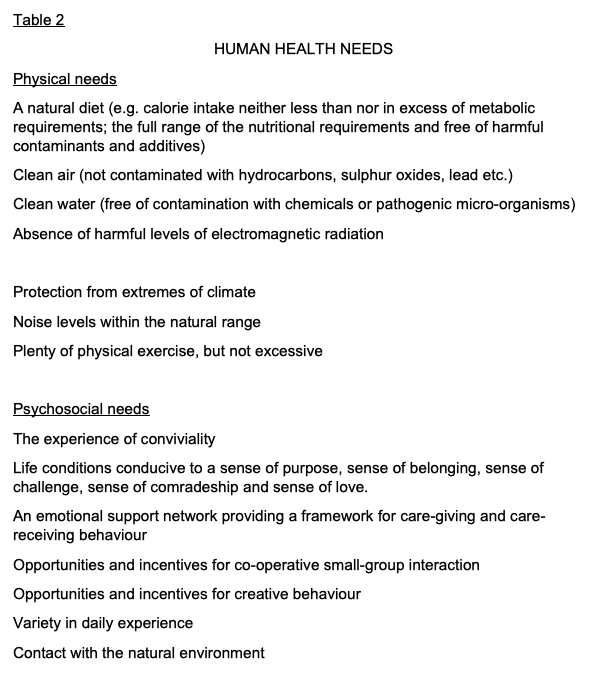
At the level of individuals and families, biosensitivity will be associated with a high quality of life. Lifestyles will satisfy people’s biologically determined health needs. A working list of important human health needs is presented in Table 2.

Attention is drawn to the psychosocial category of health needs (or health-promoting factors). Although somewhat difficult to define and measure, these intangible needs, like sense of purpose and the experience of conviviality, are as necessary for wellbeing as are a healthy diet and clean air.

In a biosensitive society these health needs will be satisfied in ways that do not result in continual growth in use of resources energy, pollution of the natural environment or loss of biodiversity. There will be more emphasis than at present on such activities as growing food, enjoying and caring for the natural environment, local sport, making music, dancing, the arts, theatre, cycling, and convivial social interaction. Rampant consumerism and fossil fuel-powered travel will not be features of a biosensitive society.

[For the rationale behind this list, see Evolution and human health]

FOOTNOTES

[1] BIOSENSITIVE This term is introduced because there is a need for a single word to describe a society with these characteristics. The expression ‘ecologically sustainable’ is widely used these days. Of course, society must be ecologically sustainable – otherwise in the long term it cannot continue to exist. But ecological sustainability is surely the bottom line. We must aim for a society that is not only sustainable, but that also positively promotes health and wellbeing in all sections of the human population, as well as in the living systems of the biosphere.

The Bionarrative

There is a story of overarching significance for every one of us and for society as a whole. It is the story of life on Earth and the human place in nature [1]. Yet this story is known and understood by only a minority of the human population. If it were understood by the majority, the prospects for humanity would be much brighter. We refer to this story as the Bionarrative.

The Bionarrative conveys a sense of perspective crucial for understanding the human situation on Earth today. It reminds us that we are living beings, products of several billion years of biological evolution, and totally dependent on the processes of life, within us and around us, for our wellbeing and survival. Keeping these processes healthy must be our top priority, because everything else depends on them.

More specifically, the Bionarrative tells us that:

Our planet is about 4600 million years old. The sun provides it with a constant supply of energy, in the form of visible light, and ultraviolet and infrared radiation.

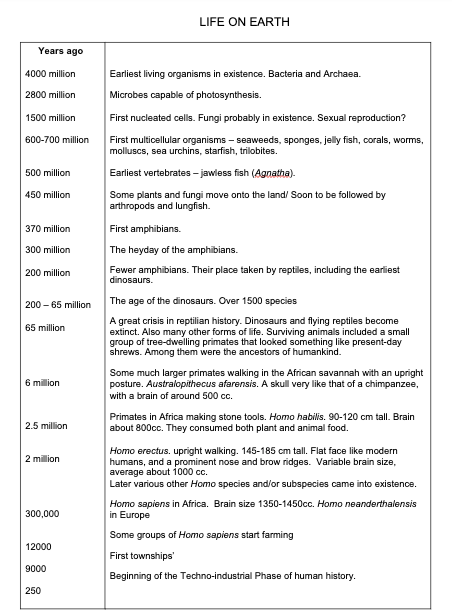
The earliest living organisms on Earth came into existence over 4000 million years ago. They were single-celled microbes, and they were the most complex form of life for over 1000 million years. There were, and still are, two distinct groups of such micro-organisms, with different biochemical characteristics. They are classified as Bacteria and Archaea. The Archaea include microbes that live and multiply under extreme conditions, such as very high temperatures and salinity.

It is believed that the main sources of energy for these early single-celled organisms were energy-containing chemical compounds that had formed through the action of ultraviolet radiation from the sun and electrical discharges in storms. But the amount of energy from such sources was strictly limited, and there was certainly not enough of it to sustain life on the scale that exists today. Microbes capable of photosynthesis came into existence around 2800 million years ago.

Microbes capable of photosynthesis came into existence around 2800 million years ago. Photosynthesis is the process by which light energy is captured from sunlight and converted complex energy-containing molecules in the organism. All animal and plant life on Earth today depends on photosynthesis in green plants.

Like bacteria today, the earliest single-celled organisms did not possess nuclei. The first nucleated cells appeared about 1,500 million years ago, and it seems that a great evolutionary diversification began to take place among living forms around this time, suggesting that a form of sexual reproduction was by then in existence. Previously, all reproduction had been asexual, involving the simple division of one cell into two. In sexual reproduction a new individual comes into existence through the union of two cells, the male and female gametes, each bringing its complement of genetic material from one of the parent organisms.

Fungi may have been in existence 1.5 billion years ago, and they were much in evidence 600 million years ago. Like animals, they get their energy and carbon from other organisms.

The first multicellular organisms came into being 600-700 million years ago. They included seaweeds, sponges, jelly fish, corals, worms, molluscs, sea urchins, starfish, lamp shells, and trilobites.

Since that time biological evolution has resulted in the coming and going of myriads of life forms, leading to the rich network of interacting and interdependent organisms that exist in our world today.

The earliest vertebrates were jawless fish (Agnatha) that lived around 500 million years ago.

The plants of the oceans have changed little since that time. In contrast, spectacular evolutionary changes took place among animals in the aquatic environment. By 200 million years ago the trilobites had entirely disappeared and were replaced by a new group of molluscs known as ammonites. At one time there were over twenty different families of ammonites, and some of them had a diameter of at least a metre. But the ammonites were also extinct by 60 million years ago.

Meanwhile there was remarkable diversification taking place among the bony fishes, leading eventually to the immense variety of fish species found in ponds, streams, rivers, lakes and oceans today.

By 450 million years ago, and possibly before this time, some plants and fungi were moving onto the land masses of the planet, soon to be followed by various kinds of arthropods. Vertebrates, in the form of lungfish, were venturing onto land 400 million years ago.later.

The early land plants evolved from a group of green algae. They included mosses, ferns and gymnosperms, like cycads, gingkos and conifers, followed much later by the angiosperms (flowering plants).

The heyday of the amphibians was around 300 million years ago. By 200 million years ago, their numbers had declined dramatically, and their place had been taken by reptiles, including the earliest dinosaurs. Birds and mammals evolved directly from the reptiles, which in turn had evolved from the amphibians.

The reptiles included the dinosaurs, which thrived from 200 to 65 million years ago There were many different kinds of dinosaur, adapted to different kinds of habitat. Several aquatic groups evolved, some of which looked very much like fish, although they did not have gills, and they breathed air through a respiratory tract. There were also various forms of flying reptiles, with wings consisting of leathery membranes, supported and extended by very elongated fingers. Some of them had a wingspan of over 7 metres.

The earliest mammals came into existence about 200 million years ago, at about the same time as the dinosaurs were emerging, and there were animals very like modern echidnas living around 150 million years ago. However, mammals remained a rather insignificant group during this period of reptile dominance.

The first true flowering plants emerged about 160 million years ago, and since that time they have undergone spectacular diversification. They are now the dominant division of plants and are made up of two main groups, the monocotyledons and dicotyledons. In the monocotyledons, which include grasses, lilies, irises and crocuses, the seedling has a single leaf and the stems do not thicken. The seedlings of dicotyledons have two leaves and the stems become thicker as the plant matures.

Around 65 million years ago a great crisis occurred in reptilian history and many forms became extinct, including all the dinosaurs and flying reptiles and most of the large marine reptiles. This wave of extinctions is thought to have been caused by the impact of a massive comet, or asteroid, landing on the Earth. Many other forms of life disappeared at this time, including various microscopic foraminifera in the oceans and many aquatic animals,

including the ammonites. Placental mammals, birds, lizards, snakes, turtles, crocodiles, fishes and plants were relatively unaffected.

After about 60 million years ago there was widespread evolutionary diversification among birds and mammals.

Estimates of the number of different species alive today are very variable. The most widely cited estimate is 8.7 million, although some authorities believe the number is much greater than this.

Some common features shared by many animal species go back a very long way in evolution. The mouth and anus were in existence 600 million years ago. Among vertebrates, two eyes, two ears, a heart and a stomach go back at least 550 million years; and four five-toed (or fingered) limbs go back to the earliest amphibians, around 400 million years ago.


HOMO SAPIENS APPEARS ON THE SCENE

During the last part of the dinosaur era around 65 million years ago, there existed on Earth a small group of tree-dwelling primates that looked something like present-day shrews. Among them were the ancestors of humankind.

Five or six million years ago there were some much larger primates walking in the African savannah with an upright posture. One particularly well-preserved fossil is that of a young female found in Ethiopia and dated about 3 million years ago. She is known informally as Lucy, and the species she belonged to has been called Australopithecus afarensis. She had a skull very like that of a chimpanzee, with a brain of around 500 cc.

Two and a half million years ago there were primates in Africa making stone tools. One species, called Homo habilis, was 90-120 cm tall, and it had a brain with a volume of about 800cc, which is about 300cc larger than the brain of a chimpanzee. These animals consumed both plant and animal food. Another rather similar species called Homo rudolfensis existed at about the same time.

After that, several different human species came into being, including Homo erectus. This was an upright walking species, 145-185 cm tall. It had a flat face like modern humans, and a prominent nose and brow ridges, with a brain size that ranged from 546 cc to 1251 cc, with an average of about 1000 cc. It existed in Africa 2 million years ago, and then spread into and across Eurasia. The latest known population lived in Java around 110 000 years ago.

The earliest ‘modern humans’, Homo sapiens, were living in parts of Africa around 300,000 years ago. They were tall people, with rounded skulls and steep foreheads, and their average cranial capacity was about 1,400cc. They had well developed chins, and their brow ridges were only moderately developed, and were not continuous from side to side. If we could bring some of them back to life, dress them in modern clothing and set them loose on a city street, they would be indistinguishable from some of the better specimens of modern humanity.

From about 200,000 years ago, and during most of the first part of the fourth, or Würm, glaciation, western Europe was occupied by a distinctive form of humanity classified as Homo neanderthalensis. These people were of stocky build and most of the men were a little over 152 cm tall, and the women a little shorter. Their skulls were flattish on top and noticeably rounded at the back, and they had a pronounced brow ridge reminiscent of Homo erectus. They had massive musculature and jaws, and the brains of adults ranged from 1,450 cc to 1,650 cc in volume. They were well acquainted with the use of fire, they hunted big game and they dressed in animal skins. They used paints to decorate their bodies and sometimes they buried their dead. The Neanderthals were displaced in Europe by Homo sapiens around 40,000 years ago.

Apart from the Neanderthals and Homo sapiens, at least three other kinds of humans are known to have been living outside Africa at about that time. Homo denisova lived across Asia and Homo longi (Dragon man) was in China. Although they are classified a distinct species, both the Neandethals and the Denisovans interbred with Homo sapiens. Dwarf hominids, called Homo floresiensis, existed on the island of Flores in Indonesia until about 50,000 years ago. They looked rather like Homo habilis.

Homo sapiens continued to live as hunter-gatherers until about 12,000 years ago, when some of them started farming. The human population is thought to have been about 5 million at that time.

Human culture

Homo sapiens possesses an attribute now unique in the animal kingdom – the ability to invent, memorise and communicate with a symbolic spoken language. This aptitude for language led to the accumulation of shared worldviews, knowledge, beliefs, attitudes and technological knowhow in human groups. That is, it led to human culture.

Human culture has recently become a new and powerful force in nature. Cultural assumptions, values and arrangements, through their influence on human behaviour, have major impacts on other living organisms and on ecosystems. There is thus constant interplay between human culture and biological systems.

Culture has led to activities that have been to the benefit of humans, referred to as cultural adaptations, and to activities that have been greatly to their disadvantage, referred to as cultural maladaptations.

The control and use of fire for cooking and other purposes was one of the turning points in cultural evolution. It predates Homo sapiens. Fire was probably in use by Homo erectus a million years ago.

The history of Homo sapiens has consisted of four quite distinct ecological phases:


Phase 1 – The hunter-gatherer phase

This was by far the longest of the four ecological phases, lasting at least 300 000 years.

As in the case of all other animal species living in their natural habitats, for most of the time most members of hunter-gatherer bands are likely to have been in a state of good health. Indeed, they had to be in order to survive and successfully reproduce under the demanding conditions of their lifestyles and environment. Because of the relatively low population density, people would not have suffered from such respiratory and enteric virus infections as common colds, covid-19, influenza, gastric flu, measles, smallpox and German measles. Nor are they likely to have experienced bacterial infections like cholera and plague. However, infection with bacteria following injury would have been a constant hazard.

Ecologically the most important culturally inspired activities in this phase were the deliberate use of fire and the manufacture and use of tools and weapons.


Phase 2 – The early farming phase

Homo sapiens had probably been in existence for around 300,000 years before farming began. It started in several parts of the world around 10,000 to 12,000 years ago. This development marked a turning point in cultural evolution. It was a precondition for all the spectacular developments in human history that have occurred since that time.


Phase 3 – The early urban phase

This phase began around 9000 years ago, when fairly large clusters of people, sometimes consisting of several thousand individuals, began to aggregate together in townships. Many of these people played little or no part in the gathering or production of food. Occupational specialisation became the hallmark of urban societies.

Although the new conditions offered protection from many of the hazards of the hunter-gatherer lifestyle, malnutrition and infectious disease became much more important as causes of ill health and death.


Phase 4 – The techno-industrial phase

This phase was ushered in by the techno-industrial revolution, which began about 250 years ago. It has been associated with profound changes in the ecological relationships between human populations and the rest of the biosphere.

Ecological Phase 4 has recently come to be referred to as the Anthropocene, and because of the popularity of this term, it will be used in the rest of this document.

The Anthropocene has seen an astounding profusion of technological innovations – from steam engines and motor vehicles to intercontinental rockets and spacecraft – and from electric lights, telephones and radios to thermonuclear bombs, computers, smartphones and the Internet.

There has been a massive intensification of use of resources and energy and discharge of wastes by humankind.

Cultural maladaptations in the Anthropocene are on a scale and of a kind that threaten the whole of humankind, as well as countless other species.


Anthropocene perspectives

Population

There are now about 1,600 times as many people alive as there were when farming began. Nearly 90 per cent of this increase has occurred in ecological Phase 4. The global population is at present increasing at the rate of 1.4 million per week.

Greenhouse gases

If it were not for certain gases occurring naturally in the atmosphere, the world’s average temperature would be 33°C colder than it is. The average temperature would be around minus 19°C instead of plus 14°C. This is because these gases trap some of the infrared radiation that escapes from the Earth’s surface. This blanketing effect results in the lower layers of the atmosphere being warmer, and the upper layers colder, than if these gases were not there. This phenomenon is known as the natural greenhouse effect.

Water vapour is responsible for about 80% of the natural greenhouse effect. The remainder is due to carbon dioxide, methane, and a few other minor gases. Carbon dioxide (CO2) is responsible for about 15% of the natural greenhouse effect. Were it not for the CO2 in the atmosphere, the Earth’s average temperature would be 5°C cooler than it is.

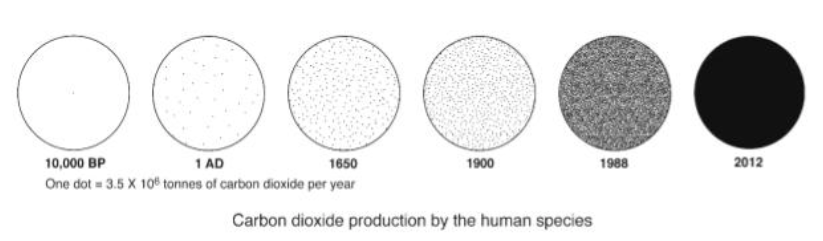
For the first 300,000 years of the history of Homo sapiens, the mixture of these greenhouse gases was relatively constant. During the past two hundred years there has been an increase in the CO2 concentration in the atmosphere – from 292 parts per million to the current 420 parts per million. This increase in atmospheric CO2 is mainly the result of two sets of human activities: deforestation, and the combustion of fossil fuels.

The amount of carbon dioxide emitted by the human population today is around 10,000 times greater than it was when farming began some 450 generations ago, and 90% of this increase has occurred over the past 100 years.


The increase in atmospheric carbon dioxide is responsible for 53% of the current global warming. Humankind has also caused the release of several other greenhouse gases, most notably methane, halogenated compounds, tropospheric ozone and nitrous oxide.

The methane (CH4) is generated by activities like production of livestock, especially ruminants, sewage treatment, distribution of natural gas and oil, coal mining and fossil fuel use. It is responsible for 15% of current global warming. Halogenated compounds, like CFCs, HFCs and PFCs, are used in various industrial processes. They contribute 11% of current global warming. Tropospheric ozone (O3) is given off during the combustion of fossil fuels. It contributes 11% of current global warming. Nitrous oxide (N2O) comes mainly from use of fertilisers and use of fossil fuels. It contributes about 11% of current global warming.

As a consequence of this anthropogenic increase in greenhouse gases in the atmosphere, the Earth’s average surface temperature has already increased by about 1°C. This is referred to as the enhanced greenhouse effect.

Sea levels are rising, and there is an increasing frequency of extreme weather events worldwide, such as powerful storms, typhoons, droughts and heatwaves. If governments do not take strong action in the immediate future, the consequences for humanity will be very serious indeed

Deforestation

Deforestation of tropical forest is occurring at an ever-increasing rate – mainly to make way for pastures for beef cattle and oil palm plantations. Only about 6 million square kilometres remain of the original 16 million sq. km. of tropical rainforest that formerly existed on Earth. Over 30 million acres of forests are lost every year due to deforestation.

Deforestation is an important influence in global warming. It has been estimated that more than 1.5 billion tons of carbon dioxide are released to the atmosphere every year due to deforestation.

Waste production and pollutants

Plastics have been introduced for manufacturing a very wide range of objects. About 9 million tonnes of plastic waste are discharged into the sea every year, and the amount has been predicted to double in 11 years. Environmental pollution with discarded plastics is causing a dramatic decline in populations of many seabirds. 5000 – 15000 turtles become entangled in discarded fishing gear every year. According to one prediction, by the year 2050 there will be more plastic in the oceans than fish.

The release into the atmosphere of chlorofluorocarbons (CFCs) and halons – gases formerly found in aerosol spray cans and refrigerants, has resulted in some thinning of the ozone

layer in the stratosphere – causing an increase in UV radiation reaching the Earth’s surface. In 1987 an international agreement, the Montreal Protocol, was signed, designed to protect the ozone layer by phasing out the production of ozone-depleting substances. As a result of this international agreement, the ozone hole is slowly recovering. It is believed that ozone layer will return to 1980 levels between 2050 and 2070.

In 1962 Rachel Carson, in her book Silent Spring, drew attention to the widespread and destructive ecological impact of DDT and other pesticides. DDT belongs to a family of synthetic compounds known as polychlorinated persistent hydrocarbons, or POPs, that are used as pesticides as well as in certain technological processes. POPs have been found to accumulate in the internal organs of living creatures and are believed to be responsible for increasing and widespread infertility in wild animals, and possibly also in humans. They may also contribute to an increase in breast cancer and reduced sperm counts in men. POPs are very persistent in the natural environment, and they have been found in the organs of animals in areas as far away from where they were released as the Arctic and Antarctic.

Three to four million tonnes of heavy metals, solvents, toxic sludge and other waste is `dumped into the world’s rivers and oceans every year.

Urban air pollution, due mainly to the combustion of fossil fuels, is a significant cause of ill health and death in many cities worldwide, especially in Asia. It is estimated that 2.5 billion people are exposed to air pollution levels seven times WHO guidelines.

Weaponry

The Anthropocene has seen an astronomical increase in the destructive power of explosive weapons. The nuclear bombs dropped on Hiroshima and Nagasaki were many million times more powerful than the ‘conventional’ bombs of World War 1, which were themselves a product of the Anthropocene. Thermonuclear bombs now in existence are several thousand times more powerful than the Hiroshima and Nagasaki bombs. There are many thousands of these bombs stockpiled across the world.

The two nuclear bombs dropped on Hiroshima and Nagasaki in 1945 killed 129,000 to 226,000 people. The thermonuclear bombs stored in the arsenals of nations across the world are sufficient to wipe out humankind many times over.

Extinctions

The history of life has been marked by a number of mass extinctions, the most severe of which occurred around 250 million years ago when around 95per cent of all marine species and 70per cent of land species were wiped out.

A mass extinction occurred about 65 million years ago. Many forms of life disappeared, including all the dinosaurs and flying reptiles. Some groups of reptiles survived, including the snakes, lizards, crocodiles and turtles. Some birds and mammals also survived.

It is believed that 99 per cent of all species that have existed on Earth are now extinct.

As a result of human activities the present rate of extinction of animal and plant species has been estimated to be 100 to 1,000 times higher than the background extinction rate, and it is predicted that 50 per cent of Earth’s higher lifeforms will be extinct by 2100.

Food production

The UN’s’ Food and Agricultural Organisation warns that the world’s agricultural systems face the risk of progressive breakdown of their productive capacity due to excessive population pressure and unsatisfactory farming practices.

Fairness

Unlike the situation for the first 300,000 years of human history, gross disparities exist in human health and wellbeing across and within human populations.


CONCLUSION

This story of life on Earth reminds us that we humans are both a product and a part of nature, and that we are totally dependent on the processes of life, for our survival and wellbeing.

It also leads us to the inescapable conclusion that present pattern of human activities on Earth is not sustainable ecologically. Business as usual will lead to the collapse of civilisation. The days of ecological Phase 4 are numbered.


[1] Note: For my own short version of the Bionarrative, see S. Boyden. 2016. The Bionarrative: the story of life and hope for the future. ANU Press. Canberra. https://press.anu.edu.au/publications/Bionarrative.
A Cultural Transformation

New understanding      ->      New worldview     ->      New society

Human activities on Earth today are on a scale and of a kind that pose a severe threat to the whole of humankind, as well as to countless other species.  If present patterns of human activity continue unabated, the collapse of civilisation is certain.

The prevailing cultures that are driving human expansion across the globe appear blissfully unaware of this ecological reality. The only hope for the future lies in a radical cultural transformation, leading to a new society that promotes health and wellbeing in all sections of the human population as well as in the ecosystems on which they depend. I refer to this transformation as the Biotransition.

This transformation can be envisaged as consisting of three distinct steps.

Step 1.  New understanding

The first essential step in the transformation will take the form of a wave of new understanding spreading swiftly across the prevailing cultures of the world – understanding of the story of life on Earth, and of the natural processes, within and around us, on which our existence and wellbeing depend, and understanding that the survival of civilisation will require major changes in the intensity and patterns of human activity on our planet.

We refer to this kind of understanding as Biounderstanding, and to the story of life as the Bionarrative.

Step 2.  New worldview

Biounderstanding will lead to a new, shared, worldview that

  • profound respect for the processes of life that gave rise to us and on which we are totally dependent

This new worldview will be the most significant difference between our current society and healthy and ecologically sustainable societies of the future.

We call this worldview Biorealism. [1]

Step 3.  New society Biounderstanding and the new worldview will lead to a society that is truly sensitive to, in tune with and respectful of the processes of life, within and around us. It will mean healthy people on a healthy planet.   We refer to a society with these characteristics as a

Biosensitive society. [1] Biosensitivity will be a guiding principle in all spheres of human endeavour.


[1] We have introduced the term ‘biosensitive’ because there is a need for a single word to describe a society with these characteristics. The expression ‘ecologically sustainable’ is widely used these days. Of course, society must be ecologically sustainable – otherwise in the long term it cannot continue to exist. But ecological sustainability is surely the bottom line. We must aim for a society that is not only sustainable, but that also positively promotes health and wellbeing in all sections of the human population as well as in the ecosystems of the biosphere.


[1] This worldview needs a name. I have wasted countless hours thinking about this, and ‘Biorealism’ is the best I can come up with. It is not perfect, but I will continue to use it until somebody comes up with a better term. I considered using the term ‘biophilia’, introduced by E. O. Wilson, but its meaning is not quite the same. It has been defined as an innate and genetically determined affinity of human beings for the natural world.

Vegetarianism

Some people are vegetarians because they believe it is morally wrong to consume other animals. I am not one of these people.  Nature created our species as an omnivorous animal, just as it created deer as herbivores and lions as carnivores. For something like 12,000 generations my Homo sapiens ancestors have been meat eaters. 

The cattle grazing on our farm would not exist if humans didn’t eat meat. They have a good life, and seem to be quite happy most of the time.

However, I feel strongly that we should completely change the slaughtering procedure. Animals should be killed instantly in the paddock or yard on the farm, and then transported to the butchery. None of this trucking long distances to sale yards, and none of the extreme fear as they are lined up for slaughter.

The ecological arguments for vegetarianism, and even veganism, are more persuasive.

The Anthropocene, or Exponential Ecological Phase of human history, has seen big changes in the size of the populations not only of humans, but also of wild and domestic animals.

It is estimated that 12,000 years ago the biomass of vertebrates on Earth was around of 200 million tonnes (mt). Humans made up one thousandth of this amount. Today the vertebrate biomass is about 930 mt, nearly a five fold increase. However, the wild animal component is reduced by 85 per cent (to 30 mt).  Humans have increased 1,500 times (to 300 mt). Domestic livestock bred for food or animal fibre, have increased from zero to 600 mt.[1]

Over 90 per cent of these changes have occurred in the past 250 years of Homo sapiens’s 300,000 years of existence.

            12,000 years ago                2000 AD
Wild animals                 200 mt                    30 mt
Humans                  0.2 mt                   300 mt
Domestic animals                    0 mt                    600 mt

The farming of animals for food production is now on a scale and of a kind that it is causing serious ecological problems worldwide.  For example, in some areas animal farming is causing significant loss of biodiversity. This is especially so in the tropical rain forests of Central and South America, where deforestation to make way for cattle is resulting in the loss of many unique animal and plant species.

Land degradation caused by overgrazing is also a serious problem, especially in dry areas of the world. Impacts include biological impoverishment of the soil, soil erosion and eutrophication of streams and rivers.

According to FAO, livestock, including poultry, account for 14.5 per cent of anthropogenic greenhouse gas emissions (in terms of carbon equivalent). 

A recent paper in the journal, Science, has highlighted the scale and seriousness of the problem, leading the authors to advocate universal veganism to save our planet.[2] They estimate that a vegan world would produce 40 percent less food-based greenhouse gas emissions, 50 per cent less acidification on land, 49 per cent less eutrophication, and would use 19 per cent less water; and it would cut land us by 76 per cent. They point out that there is big variation in the environmental impact of different farming practices. It has been reported that the world’s 10 per cent worst beef producers emit 12 times more greenhouse gas, and takes up 50 times more land, to produce a unit quantity of protein, compared to the best 10 per cent.

Referring to this paper, George Monbiot of the Guardian, writes:

We can neither feed the world’s growing population nor protect its living systems through animal farming. Meat and dairy are extravaganza we can no longer afford.[3]

So, apparently, we have a sad situation.  For some 300,000 years humankind fitted in to the biosphere much like any other omnivorous species, and although there were fluctuations in population from time to time, there were never enough people to threaten the integrity of the ecosystems on which they depended. After the introduction of agriculture around 12,000 years ago, the human population began to increase and there are now 1,500 times as many people on Earth as there were when farming began. At present the population is growing at the rate of around 1.4 million each week.

Perhaps the advocates of veganism are right. The population has now reached such a level that we must stop eating meat, which was such an important part of the natural diet of our species.  We must to shift to an unnatural diet to save the planet, simply because there are so many of us.

Not surprisingly, there has been a backlash from supporters of the meat industry. Critics suggest the paper in Science is too narrow. They ask: Why single out meat production, when there are so many other human activities threatening the integrity of the biosphere? Activities like producing palm oil and soya bean oil and the use of fossil fuels, and even keeping pet dogs and cats, make a huge contribution to the unsustainability of modern society?  They draw attention to the fact that, in some parts of the world, populations depend on meat eating for their very survival, and that well managed grazing pastures can have a positive effect on biodiversity.

In my view, the facts assembled in the Science paper are probably sound, and the production of meat and dairy products, along with various other human activities, is threatening the living systems that underpin our existence.  The crux of the problem is that there are vastly too many humans on Earth.


[1] These figures are based on information assembled by Paul Chefurka (see http://www.paulchefurka.ca).

[2] J. Poore and T. Nemecek. 2018. Reducing food’s environmental impacts through producers and consumers. Science 360. Issue 6392. Pp.987 – 992. X

[3]  G. Monbiot. 2018. The best way to save the planet? Drop meat and dairy. Farming livestock for food threatens all life on Earth. The Guardian Weekly. 199. No.2 p.48.